The Marowijne, a broad tropical river running along the border between Suriname and French Guiana, is both a national boundary and a lifeline for the people who live on it. This article looks at the character of the river, at the fish that are actually caught in it, and at the pressures the fishing communities are under.
The Marowijne: A Short Introduction
The Marowijne, known as the Maroni on the French side, rises in the Guiana Shield and empties into the Atlantic Ocean. The river system runs to roughly 610 kilometres, with clear, mineral-poor water in its upper reaches. It passes through a sequence of quite different environments, from fast-flowing creeks to quiet estuary, and that variety is where its biological richness comes from. The naming can confuse a visitor reading a map: upstream the same water is called the Lawa, and above the confluence at Antecume-Pata it divides again into the Litani and the Malani.
The catchment covers somewhere between 66,000 and 69,000 square kilometres, which makes this one of the largest river systems in the Guianas. That area holds a wide range of habitats, from small catfish in muddy, low-oxygen backwaters to large predators in open water, and it is why the river matters as much to the people living along it as to anyone studying it.
Fish Species in the Marowijne
Before any list of names, one caution that will save a visitor some confusion: local names for the same fish differ between Wayana, Aluku and Lokono usage, and between the Surinamese and the French banks. A name you are given in one village may mean nothing in the next one, and names that circulate in travel writing about the river are often not names anyone on it uses. Ask what a fish is called where you are, and write down what you are told rather than what you read.
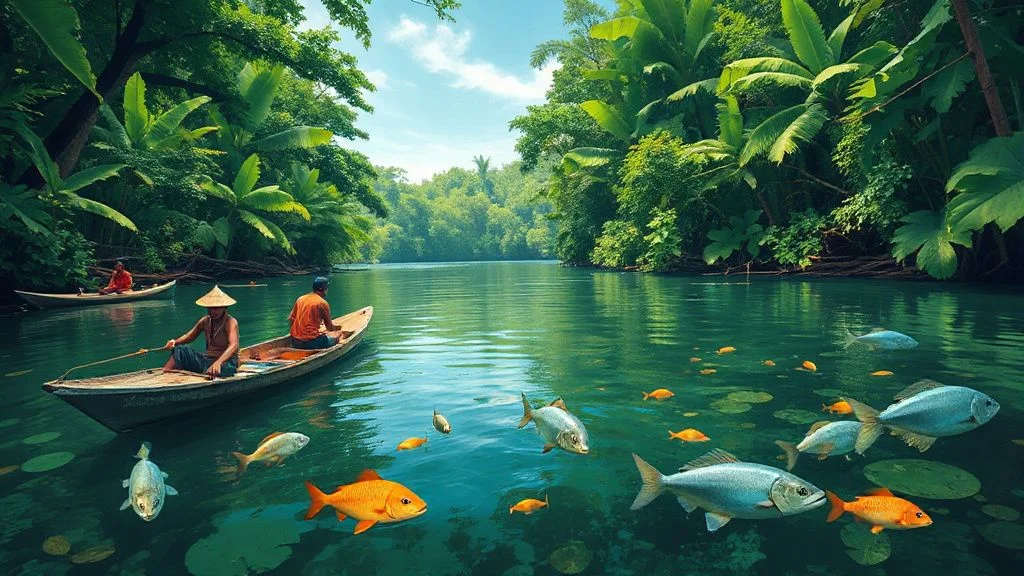
What is documented for Surinamese waters gives a reliable picture of the kinds of fish involved. The kwiekwie, Hoplosternum littorale, and the related armoured catfish Megalechis thoracata are both eaten locally and live in exactly the muddy, oxygen-poor stretches that the lower river provides. Characins such as kwimata, Prochilodus rubrotaeniatus, and moroko, Brycon falcatus, are part of the same catch. One species, Harttia guianensis, is recorded with the Marowijne specifically as its habitat. Alongside these the river holds cichlids, which are numerous and conspicuous, and larger predatory fish taken with hook and line.
The Impact of Pollution
The fish stocks of the Marowijne are under threat from pollution, caused mainly by illegal gold mining. Miners put mercury into the rivers, which harms the fish and then the health of the people who eat them. Fishermen in villages such as Kawemhakan, a Wayana village on the Lawa, report that catching fish has become steadily harder, which puts pressure on a resource they depend on directly.
Advice has been issued about eating fish from affected areas, and it is worth being precise about what that advice is, because it is often described as a ban and is not one. What exists is guidance on consumption, and its content differs from one area to another and from one species to another, since mercury accumulates most in large, long-lived predatory fish. The practical consequence for a community is the same either way: a need for alternative sources of food that has not been adequately met.
Fishing Communities and Their Way of Life
The fishing communities along the Marowijne have a deep relationship with the river. Fishing is not only a source of food but a way of living that is bound up with culture and tradition. Fishermen use methods and gear developed over generations, generally with a working respect for the ecosystems they operate in.
The river also offers real scope for ecotourism, where visitors can learn about local fishing and about the ecological value of the Marowijne. Done sustainably, this can be an important source of income for the communities; done badly, it becomes another extraction.
The Role of Education and Sustainability
Education plays a central part in securing the future of fishing on the Marowijne. Local organisations and NGOs work with the communities to build awareness of what pollution does and of why sustainable practice matters. That work includes training in alternative fishing methods and encouraging aquaculture as a way of taking pressure off wild stocks.
Developing fish farms can also address the problem the communities face when their traditional grounds are contaminated. It reduces dependence on the wild catch and supports the local economy at the same time, which is why it appears in most serious proposals for the region.
Practical Tips for Visitors
For travellers who want to visit the Marowijne and its fishing communities, a few things are worth keeping in mind. The first is that local culture and tradition here are tied closely to the river itself. Respect for local custom and for the environment is not optional politeness; it is the condition on which you are a welcome guest.
Beyond that, consider joining ecotourism initiatives that support the communities directly. That can make for a better experience and also contributes to the sustainability of the region. Work with local guides who know the area and the ecological pressures the communities are facing, and ask them about the fish: they will tell you more in an afternoon than any species list.
Conclusion
The Marowijne is a crucial ecosystem that holds a rich biodiversity and also provides a living for communities in Suriname. The fish in this river are central to the food and the culture of the people on its banks. Pollution and its consequences are a serious threat to both the stocks and the health of those communities. By choosing sustainable practice and supporting ecotourism, visitors can contribute to keeping this resource intact.